Famous, but difficult
If you do tarot at all, the Celtic Cross is one spread you simply cannot not know. But everyone has, at least once, been brought to their knees before those ten cards — which is why it's also a spread of considerable notoriety. And beyond the sheer number of cards, there's another serious problem: multiple versions exist for how the cards are laid out and how they're read, so two people can be using the same name, Celtic Cross, and mean different things by it. You'd assume a spread this famous would follow one set of rules for everyone — but no. So when someone else brings you a Celtic Cross, you should do what you'd do with any tarot spread: first confirm "which version of the Celtic Cross is this, and how was it used" before you read. Imagine pointing at each other's past card and future card in reverse and arguing over who's right — that would be absurd.
The early version
The person who made the Celtic Cross the most famous spread in tarot is none other than Arthur Edward Waite, widely known for the Rider-Waite deck. The deck he designed remains an all-time steady seller and bestseller, still flying off the shelves to this day. In his book "The Pictorial Key to the Tarot," Waite introduced the Celtic Cross as an ancient Celtic method of divination.
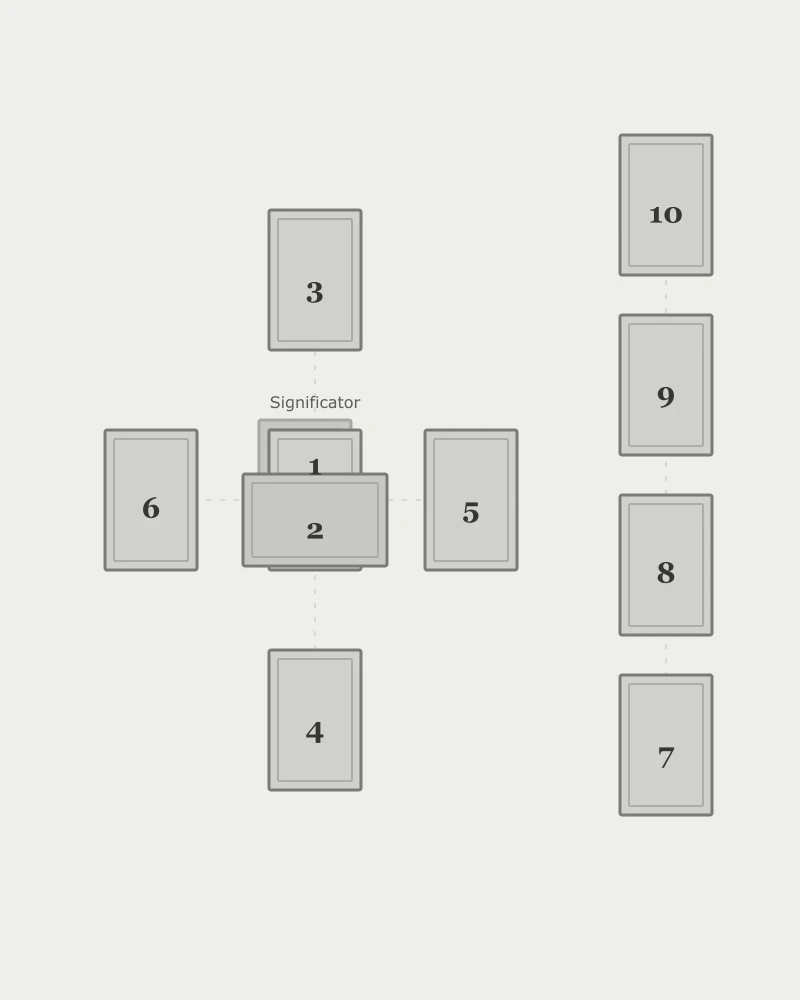
The Significator
1. That covers him
2. What crosses him
3. What crowns him
4. What is beneath him
5. What is behind him
6. What is before him
7. Himself
8. His house
9. His hopes or fears
10. What will come
Waite's Celtic Cross uses a total of eleven cards, including "The Significator." The Significator is a position where, out of the tarot's 78 cards, one card matching the querent's appearance or the subject of the question is laid down first — and it becomes the reference for the thoughts and actions of all the other cards. When the other cards exert their influence, you read by considering how the Significator would have responded.
Beyond the Significator, another distinctive feature is No. 5, "What is behind him," and No. 6, "What is before him." These two cards have no fixed left or right position. Based on the gaze direction of the figure drawn on the Significator card, No. 5, "What is behind him," is placed at the figure's back, and No. 6, "What is before him," is placed before the figure's eyes.
The variant versions
As time passed, the Celtic Cross gradually shifted away from the form Waite first presented. Then again, the moment Waite borrowed what was supposedly an ancient Celtic divination method may have been where the transformation began in the first place.
The person who truly set off a storm of variation was Eden Gray, author of "The Tarot Revealed." In that book, Gray introduced a method of placing cards 3/4/5/6 by rotating them clockwise. The resulting sequence — a temporal flow of beneath → behind → crowns → before — was good for threading a narrative and easy to memorize as a placement order, and before long it spread widely, becoming something like the new standard for the Celtic Cross. Critics did point out that a circular placement starting from the bottom sits poorly with mystical philosophy, and that the gaze symbolism of the Golden Dawn tradition was lost — but the sheer convenience overwhelmed all of it.
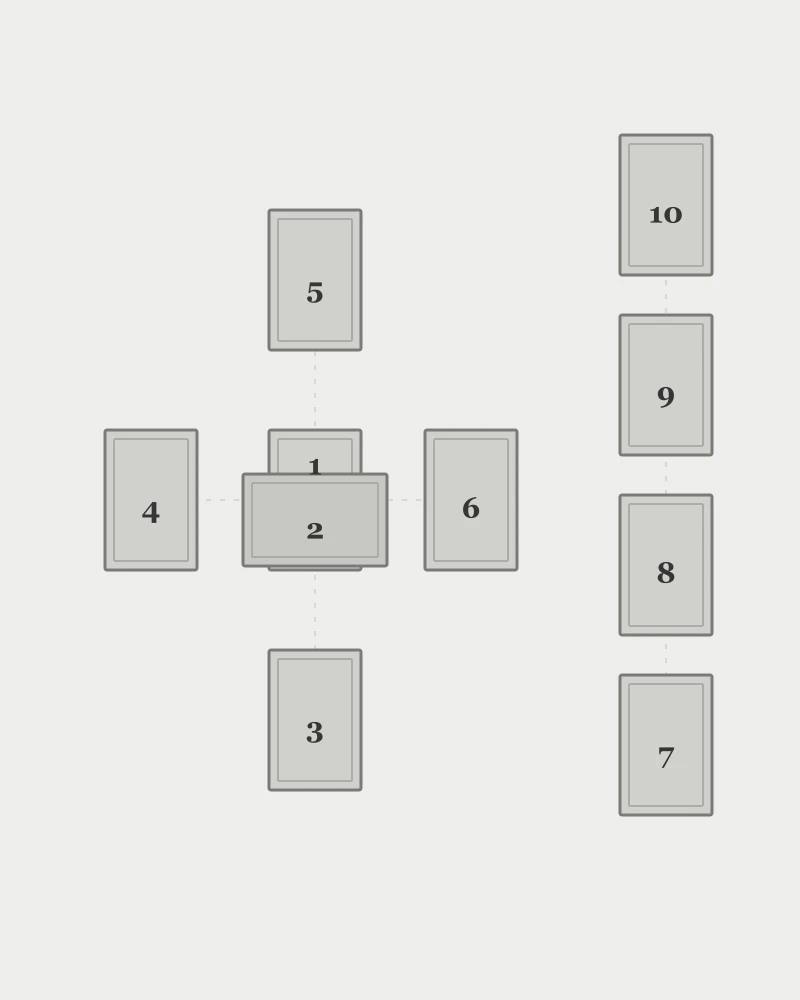
In Waite's Celtic Cross, the positions of No. 5, "What is behind him," and No. 6, "What is before him," were determined by the gaze of the figure on the Significator card. In Eden Gray's Celtic Cross, cards 3/4/5/6 came to hold fixed positions, so placing No. 5 and No. 6 no longer required any such judgment. Meanwhile, the times were turning against racial discrimination and sorting people by appearance, and the part of the Significator's selection criteria that matched the querent's looks came under fire. For these and other reasons, omitting the Significator became more and more common — until at last the Significator vanished from the Celtic Cross and faded into history.
The version mainly used in Korea today takes Waite's Celtic Cross, drops the Significator, and adopts Eden Gray's placement for cards 3/4/5/6. Only the placement of 3/4/5/6 is Gray's — the meanings of the cards all remain exactly as in Waite's Celtic Cross.
The SCHEMAcards version
I mostly follow the placement order and card roles of the version currently popular in Korea, while additionally applying my final card rule.
1. Present situation
the situation the querent is in, seen through the querent's own eyes
2. Obstacle
what stands in the querent's way
3. Unconscious motive/undercurrent
the unconscious motive the querent has been missing
4. Recent past
the immediately preceding experience still affecting the querent
5. Conscious aim/expectation
the querent's conscious aim, based on their own prediction
6. Near future
the possible next development along the querent's trajectory
7. Self-perception
the person the querent believes themselves to be
8. Surroundings
the people and environment around the querent, and external pressure
9. Hopes/fears
what the querent wishes for and what the querent avoids
10. Core frame/theme/title
the governing theme presiding over all the cards, the largest principle driving this matter
Look closely at each card's label and role, and you'll see that most of the cards in the Celtic Cross are built from the querent's subjective viewpoint. That includes No. 6, "Near future," which people usually assume is the exception. This card isn't a prophecy dropped from the sky — it's a picture that anticipates the shape the preceding cards are converging toward. No. 8, "Surroundings," likewise speaks of circumstances the querent can call up in their own awareness. So in the end, only two cards stand outside the querent's subjective viewpoint: No. 2, "Obstacle," and No. 10, "Core frame/theme/title."
The final card
My final card rule is this: take the card placed last in the spread and define it as the core frame, theme, or title of the reading — while, in the same motion, making it the reference point that governs all the other cards. The final card lays out in advance the core principle on which the reading runs, and the remaining cards carry their own flows forward on that footing. I use this rule actively with spreads that close on an "outcome" position, like the Celtic Cross, and with Grouped Line spreads, where no card carries a label.
In an actual reading, there's no need to check every single card against the final card. Aligning a few confusing cards toward the final card's reference point is plenty. This is especially true in the Celtic Cross, where there are so many cards that the neighbors beside, above, and below are already offering hints. Let me give an example.
The question
I've switched my project partner from GPT to Claude — will things be okay going forward?
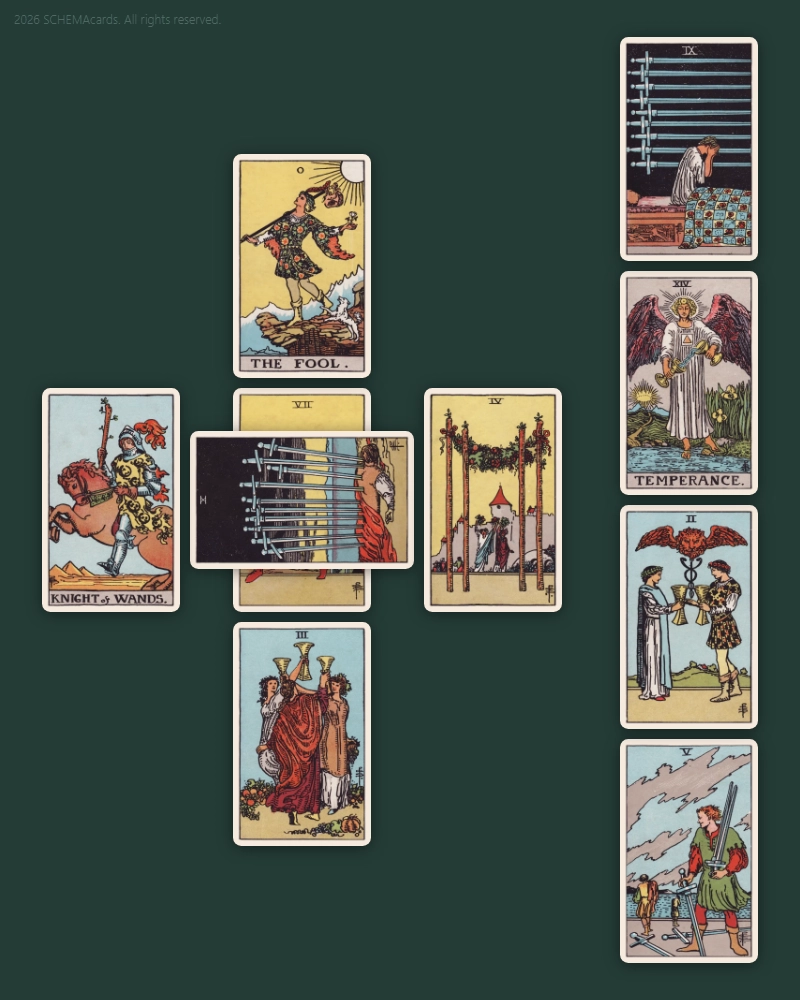
Cards worth checking against the final card
Seven of Swords
Wondering whether switching to Claude might end up making the project worse. → Checked against the Nine of Swords: the math has tipped toward the bad side in advance, all on its own.
The Fool + Four of Wands
Planning to entrust even more to Claude going forward — could that be the wrong choice? → Checked against the Nine of Swords: it's already in use, so there's no point agonizing over it further. Nothing bad seems likely to happen, either — just settle in well.