All over the map
The cross spread arranges its cards in an intuitive cross shape that anyone can recognize at a glance. But not every spread laid out in a cross shape is the same cross spread. The order in which the cards are placed to form the cross differs from person to person, of course — and the labels assigning each card its role differ too, not as mere variations, but completely, from one person to the next. So when you see a cross spread in someone else's hands, it's best to assume it is not the cross spread you know.
The SCHEMAcards version
Among the many versions of the cross spread, I use the one designed by the reader at the Cheongchundang fortune-telling house. This version compresses the left half of the Celtic Cross — that is, cards 1/2/3/4/5/6 of the Celtic Cross — into five cards.
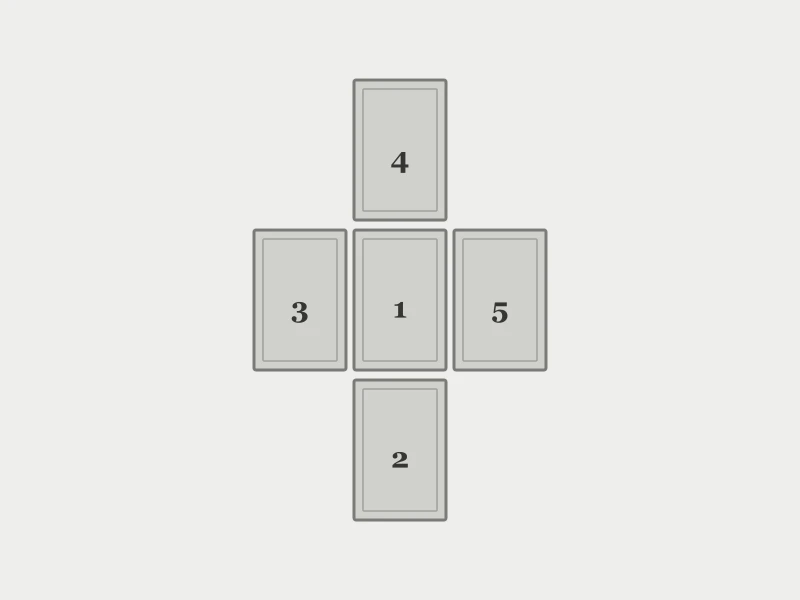
1. Present situation
2. Unconscious motive/undercurrent/obstacle
3. Recent past
4. Conscious aim/expectation
5. Near future
The first thing you'll notice is that the right half of the Celtic Cross — cards 7/8/9/10 — has been omitted.
What remains is the left half of the Celtic Cross. In No. 2, "Unconscious motive/undercurrent/obstacle," the Celtic Cross's "Obstacle" and "Unconscious motive/undercurrent" have been merged into a single card. At first glance this looks like a simple blend of two cards, but it's not that simple. In the Celtic Cross, the "Obstacle" is a card that actively reflects external forces, while the "Unconscious motive/undercurrent" is a card that represents the querent's interior, and nothing but. Two properties that point in opposite directions — the interior formed within the querent, and the external force bearing down from outside — are held inside one card. Common sense says you cannot run an unconscious motive as an external force. It's the obstacle that has to give a step. So in this spread, the better adjustment is to treat the obstacle not as an external force but as an "inner obstacle" lurking in the querent's unconscious.
Taken as a whole, this spread suits a sequential interpretation — working through the cards in order from No. 1 — and it reads fairly easily that way.
1. Present situation
No. 1, "Present situation," is not an objective view of the event or incident. It is the situation the querent finds themselves in as seen through their own eyes, together with the querent's attitude toward it — thoroughly subjective. Start by meshing this card with the question, and you'll be able to trace or anticipate what the remaining cards are pointing to.
2. Unconscious motive/undercurrent/obstacle
No. 2, "Unconscious motive/undercurrent/obstacle," is the unconscious motive the querent has been missing, and at the same time the inner obstacle lurking in the querent's unconscious. This card indirectly shapes the querent's subjective view — the one you observed in No. 1, "Present situation." Because this card often turns up personal tendencies the querent keeps hidden, or old traumas, you must not use it to make pronouncements as if exposing someone's truth. That's not a technical issue — it's a matter of the counselor's attitude toward the person sitting across from them.
3. Recent past
No. 3, "Recent past," is the immediately preceding experience that still affects the querent. This card directly shapes the querent's subjective view of No. 1, "Present situation." So read No. 1, "Present situation," first, then look at No. 3, "Recent past," alongside No. 2, "Unconscious motive/undercurrent/obstacle" — and you'll understand the querent's stance: why, in No. 1, the querent treats this matter the way they do.
4. Conscious aim/expectation
No. 4, "Conscious aim/expectation," is the querent's conscious aim based on their own prediction — a glimpse of how the querent expects this matter to unfold. This card is no stray loner appearing out of nowhere. It grows out of the histories that make up the querent — cards 1/2/3. What situation is the querent in; what interior and what recent experience formed the attitude with which they view that situation; and given all that, how is the querent predicting this matter will go? Read this card tinted with the flow of the cards before it. And from there, look at what course the querent is inclined to take next.
5. Near future
No. 5, "Near future," takes influence from No. 2, "Unconscious motive/undercurrent/obstacle," and No. 3, "Recent past," and above all it shows what picture No. 4, "Conscious aim/expectation" — laid over No. 1, "Present situation" — will ultimately draw. So the "near future" this card speaks of is no revelation handed down from the sky; it is the shape molded by the flow of the cards before it. Close the reading by checking whether that final picture really does follow naturally from the querent's course.