What is a Grouped Line spread?
Among tarot spreads, a Grouped Line spread is a line spread in which the role of each card hasn't been designed in advance. When people hear "three cards" in tarot, they usually picture labels like past / present / future. In a Grouped Line spread, the cards carry no such labels.
The resilience of the Grouped Line spread
In Korea, the Grouped Line spread has taken quite a beating over the years. Among tarot readers who prize spread structure and the defined role of each card, some couldn't stand the sight of it. Among seasoned readers with long years of card work behind them, some looked down on it as a beginner's mistake. And yet, through all that abuse, the Grouped Line spread survived — far from disappearing, it has been picked up by more and more readers in recent years. Here's how I think about that staying power:
"It's like the word 'ain't' — scolded as wrong for generations, yet so widely spoken that the dictionary finally had to let it in as standard too."
Tarot works with language, builds storytelling, and carries meaning from one person to another in spoken words. If a method not only refuses to die under pressure but keeps spreading, doesn't that suggest it was actually a rather good way of delivering the language of a reading to the querent? It's time to stop casting it out as a heretic who broke with tradition, and start asking instead: "How do we read it better?"
The many ways to read a Grouped Line spread
One reason the Grouped Line spread gets rejected is that there is no single fixed way to read it — it varies wildly from person to person. In practice, these three approaches seem to be the most common:
1. No labels attached, but unconsciously reading along a temporal flow like past / present / future
2. Setting tense aside and reading along a narrative or logical flow
3. Taking in the whole picture and reading the imagery that rises from it
Honestly, there's no way to say which of these is right or wrong. But isn't that odd? Most tarot spreads are read differently by different people to begin with. Even famous spreads like the Celtic Cross or the Horseshoe exist in multiple variations. And unlike other forms of cartomancy, tarot has a strong tradition of readers using spreads of their own making alongside the ones handed down — sometimes even laying cards out improvisationally, with no spread at all. So rejecting the Grouped Line spread merely because people read it differently is the wrong frame. And the flawed move of asking others to weigh in on your reading without disclosing which spread you used and how you read it — that's a familiar sight everywhere, Grouped Line or not.
How SCHEMAcards reads a Grouped Line spread
I read a Grouped Line spread not as a temporal flow but as a vector flow. Lay the cards out in a horizontal row, take in the whole, and read the vector motion pushing from left to right. The force of the earlier card on the left flows into the card to its right and, in the same motion, pushes that card forward. The vocabulary is grand enough to be a little embarrassing, but it's actually a very basic method.
The question
What would it take for SCHEMAcards to make good money?
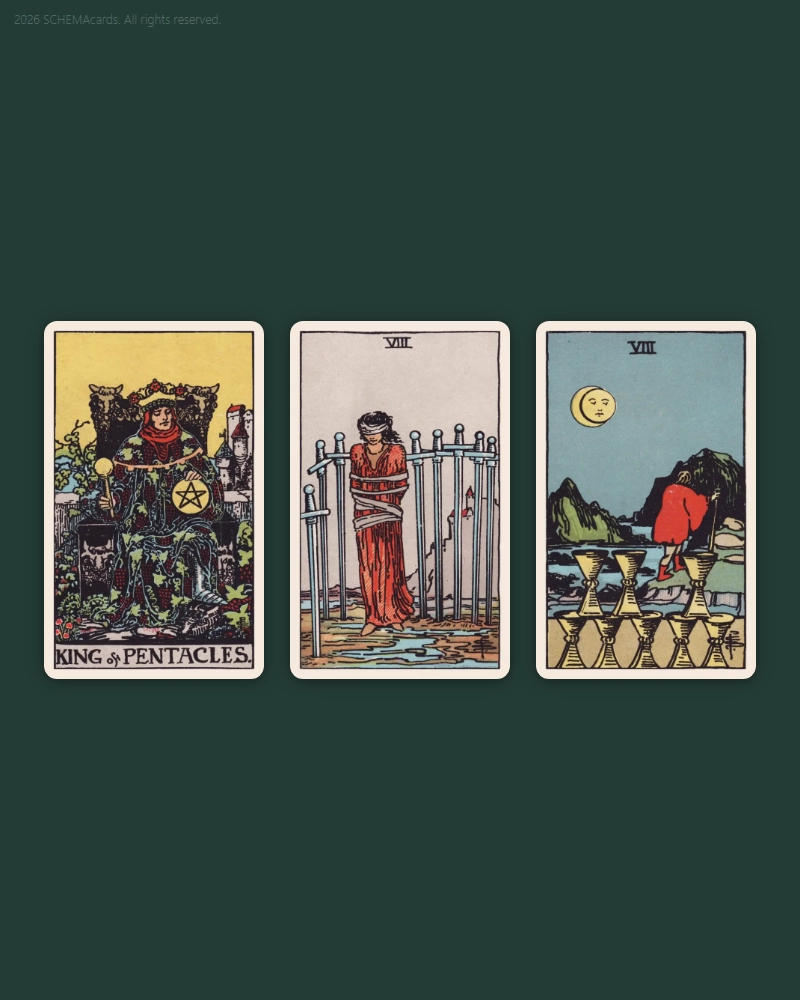
Vector interpretation
There's a shortage of will to compete actively.
carried by the force of the King of Pentacles on the left
→ With no drive, there's no thought of going out to look for methods. So the only things that come to mind are the common approaches floating around in plain sight.
carried by the force of the Eight of Swords on the left
→ A common approach isn't a failing approach. If anything, it's perfectly serviceable. But it feels unexciting, so nothing about it quite catches the eye.
The final card
And on top of this comes my final card rule.
My final card rule is this: take the card placed last in the spread and define it as the core frame, theme, or title of the reading — while, in the same motion, making it the reference point that governs all the other cards. The final card lays out in advance the core principle on which the reading runs, and the remaining cards carry their own flows forward on that footing. I use this rule actively with spreads that close on an "outcome" position, like the Celtic Cross, and with Grouped Line spreads, where no card carries a label.
Applied to our example: the Eight of Cups, placed last, is the core frame and theme of this reading — its title. Guided by the Eight of Cups, you simply push the remaining cards along, and they follow naturally.
The final reading
The core of this reading is that what makes this hard is nothing other than the heart. The market is perfectly viable, and yet the will to compete actively — that is, the heart — just isn't there. With no drive, there's no thought of going out to look for methods, so the only things that come to mind are the common approaches floating around in plain sight. But look at it another way: a method everyone reaches for is, if anything, proof that it works reliably. Even if the common way doesn't appeal, unless a sharper move presents itself, that's the one to try.