Five Card Horseshoe
Like other tarot spreads, the horseshoe spread exists in multiple versions. Among them, I use the Five Card Horseshoe version widely popular in Korea.
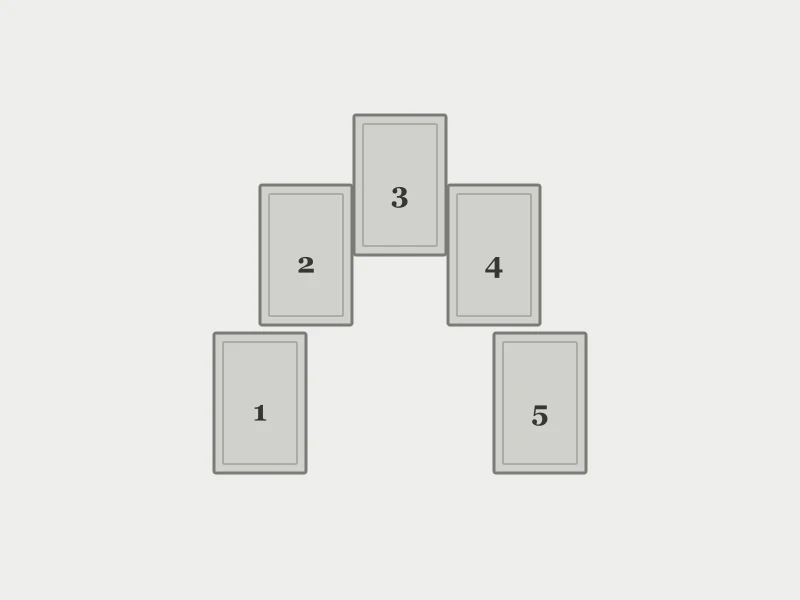
1. Your Attitude/Present
2. Expectations
3. The Unexpected
4. Near Future
5. Far Future
The Five Card Horseshoe has no clear source, so its origin can't be pinned down exactly. But look at No. 2, "Expectations," and No. 3, "The Unexpected," and they bear a striking resemblance to "What You Expect" and "What You Don't Expect" from playing-card divination, which has a long tradition behind it. Just as decks like tarot, Lenormand, and Petit Etteilla readily show traces of the suits and ranks that make up playing cards, it seems the rules of playing cards peek through in spreads as well.
In Korea there has been a small debate over these two cards: should No. 2, "Expectations," and No. 3, "The Unexpected," be interpreted as "what you want" and "what you don't want," or as "what you expect" and "the unexpected"? I adopted the latter, giving No. 2 the label "What you imagine will happen" and No. 3 the label "What could surprise you" — and I have my reasons.
Not snapshots, but a video
When I read a spread, my view is that the cards within it are not a row of separate snapshots but one continuously flowing video. That way, no blank space opens up between the cards, and every card holds tight plausibility with every other. Carry the reading forward from card to card with "so" or "and" rather than "but," and plausible storytelling becomes possible without ever filling blanks with imagination. And to say that all the cards hold plausibility with one another is to say, in other words, that the past flow shown in the earlier cards breathes force into the future card. So the future card isn't a prophecy dropped from the sky — it's the shape molded by the flow of the cards before it. Seen from this viewpoint, moving from "what you expect" and "the unexpected" into the near future makes for a more plausible process of convergence than moving there from "what you want" and "what you don't want" — which is why I write the labels the way I do.
Far Future
From the same viewpoint, the "far future" of No. 5, "Far Future," is more naturally handled not as some remote, distant someday, but as the very next step following on from the near future. The phrase "far future," however, creates a great temporal distance as if it were the most obvious thing in the world. And if you set the gap between the near future and the far future too wide, a blank opens between the two cards — and at the same time, the plausibility between them disappears. In the end, No. 5, "Far Future," even with no one intending it, winds up behaving just like a prophecy dropped from the sky.
So I rewrote No. 5, "Far Future," under the label "Looking back from the far future." It clears up the misunderstanding the vocabulary invites, and it's designed so that the reading can close beautifully — looking back over the preceding cards, with no need to agonize over the distance from the near future to the far.
The SCHEMAcards version
1. Your present attitude, your present situation
2. What you imagine will happen
3. What could surprise you
4. Near future
5. Looking back from the far future
1. Your present attitude, your present situation
No. 1, "Your present attitude, your present situation," is not an objective view of the event or incident. It is the situation the querent finds themselves in as seen through their own eyes, together with the querent's attitude toward it — thoroughly subjective. Start by meshing this card with the question, and you'll be able to trace or anticipate what the remaining cards are pointing to.
2. What you imagine will happen
Coming right after it, No. 2, "What you imagine will happen," has bloomed out of No. 1, "Your present attitude, your present situation." If No. 1 were an objective present rather than a subjective one, there would be no guarantee that No. 2, "What you imagine will happen," was formed from it. But in this spread No. 1 is a subjective view, and so No. 2, "What you imagine will happen," becomes storytelling that can bud from it.
3. What could surprise you
What makes this spread special is No. 3, "What could surprise you." Like the obstacle card in the Celtic Cross, it's a powerful variable that reflects external forces. It lets you consider the unforeseen, of course — but set No. 2, "What you imagine will happen," and No. 3, "What could surprise you," side by side and trace the gap between expectation and variable, and you'll find yourself tasting every joy and sorrow that human affairs have to offer.
4. Near future
When reading No. 4, "Near future," look for which route it arrived by — the expectation of No. 2, or the variable of No. 3. Depending on whether it came just as imagined or from somewhere unforeseen, the face with which you meet No. 4, "Near future," will change completely.
5. Looking back from the far future
No. 5, "Looking back from the far future," is, as I mentioned earlier, a label I newly attached from my own personal viewpoint. Retracing all the cards that came before, you can close the reading by quietly surveying what this story was — and what, in the end, it has come to remain as.